Showing posts with label ruminations. Show all posts

Renewal

By Lise Alschuler, ND, FABNO
AANP Past-President (2008-2009)

Photo by Katherine via Flickr, used under the Creative Commons License.
October is the month of my birthday. As such, I have long experienced October as a unique flow of emotions and reflections. As my birthday approaches, I find myself awash in the incoming tide of anticipation and the receding tide of closure. As my current year runs itself out, a peaceful sense of finality spreads its way into my consciousness. I reflect on my prior year with feelings of gratitude and deep appreciation for all of my experiences. I find myself letting go of unresolved issues and troublesome questions. It is as if I am at a door looking back into a room that holds all the experiences of my past year. I see the way the room has been arranged; I note the piles and the empty spots; I see the shafts of sunlight streaming in here and there; I notice dust in a few places. I see all this with quiet, peaceful eyes, and then, I gently close the door behind me.

Ahead of me is my next year – a year I don’t know yet. I have no sense of it yet, but feel its eagerness. I feel the pull the future reaching out for me – stretching its fingers towards me, excitedly drawing me forward. I find myself reaching back, perhaps a bit tentatively at first. I feel curious and then anxious, impatient and then hesitant. All the while, as my new year looms ever closer, l find myself leaning further forward. There comes a moment when I will lean too far to stay in place and I fall forward into the outstretched arms of my future.

As a fall, I experience another kind of letting-go. I have no ability to right myself or change the course of my fall, so I accept my fate – utterly and completely. I recognize in that instant of acceptance, that wherever I land is perfect. I have no need to resist, but instead celebrate with joy as l free fall towards my future. In that moment, my birth-day happens. I experience a feeling of renewal that reverberates all the way into my very bones. I am born again and as I emerge into my new year, I do so with a prayer of thankfulness on my lips.

Our Task: Loving Self-Expression

By Lise Alschuler, ND, FABNO
AANP Past-President

Photo by David 23 via Flickr, used under the Creative Commons License.
It continually amazes me how easy it is to become completely ensnared with daily challenges in our lives. As we strive to create perfection in our work, our relationships, even our creative outlets, things can get tough.

Last week, after several busy days of work, I was running late one morning. I was irritated that I was late and, as can happen, my irritation distracted my attention from how I was carrying my coffee. I spilled it all over my pants on my way to the car. I had to head back into the house, figure out a whole new outfit, change into it, and then get back into the car. By then I was really late, plus I was missing my coffee. As I drove to work, it seemed that every slow and nonplussed driver was in the fast lane. My frustration started to rise, my expletives escaping my clenched teeth.

Then, suddenly, grace interceded. In a moment of clarity, I saw all this for what it was – just silly superficial things that had nothing to do with the true purpose of my day. I was able to smile, relax my grip on the steering wheel, and relax into the truth and beauty of the moment.

Later, upon reflecting on this change of heart, I recalled some words that my father once shared with me. These words were received by him from his spirit guide:

What is a new adventure for you is for us a continuation of the same learning problem. It is new for you because it is a different situation, in a different place, with different opportunities and constraints. These are the surface manifestations, but natural focal points for people with bodies, connected so intimately with the Earth. We, on the other hand, are deprived of your distractions. We cannot see those things. Thus they are of little concern to us. What matters from our limited, in its own way, point of view is the degree to which heartfelt feelings are expressed in loving ways, the degree to which those feelings are translated into actions that improve the Earth, the home of our children, and how much closer you come to us in spirit.

I find these words to be both soothing and admonishing. With life so precious and so alarmingly short, our ability to express ourselves in loving ways for the good of all is exactly the task at hand.

Tempus Fugit

By Jacob Schor, ND, FABNO

Last June, Louise Edwards, ND, (who had occupied our guest room the night before) helped me load a grandmother clock into the back of my car and haul it home. We’d been for a walk in the park with the dog and stopped at an estate sale on the way home. Not only did we leave with the grandmother clock (a smaller version of a grandfather clock), but also a new nightstand for her bedroom. Well, actually Rena and my guestroom, but since Louise is such a frequent guest, we sometimes refer to it as Louise’s room.

The clock has the Latin words "Tempus Fugit" on the faceplate. This seems to be a common thing on clocks. It translates, of course, to mean, “time flies.”

Given that the clock chimes on the quarter hour, it certainly enforces that thought. Rena and I have gotten into the habit of saying "tempus fugit" out loud each time the clock starts to chime away. It adds a bit of urgency to what already felt like busy days.

Thus when we attended the AANP convention this past month in Arizona, it’s those two words that started echoing in the back of my mind, something of a little mantra. Over the last few years at each of our conventions, time has been set aside to remember colleagues who are no longer with us or who, at the present, are in such need of divine intervention, that I suppose we figure that some sort of communal prayers won’t hurt.

This year is was Konrad we remembered and Molly we prayed for.

Time flies. None of us are getting younger as the saying goes. We are fast approaching the time when losing colleagues will not be a rarity but for will seem all too commonplace.

On our website Rena and I have a photo posted from the 1934 convention of the American Naturopathic Association:

A group photo from the 1934 convention of the American Naturopathic Association at the Albany Hotel in Denver, CO.

At the time the picture was taken (probably using Kodak black-and-white film), the American Naturopathic Association was celebrating its 38th annual congress.

Time flies. From the look of these delegates, as smartly dressed as they were, the majority, if not all of them, were long passed before the first AANP convention.

Time flies. Our profession experienced a resurgence over the last few decades and that first wave of new doctors are not getting any younger. It will only be so much longer that we have to listen to stories about going to school in Kansas. At some point Kansas will be a secondhand memory.

Time flies. That clock keeps ticking and chiming away the minutes as I write. I’d swear it was going faster and faster. My beloved wife has developed a habit of reminding me that our life together may be more than half over. It’s a sure way to cut the foundation out of any disagreement we might be having. We have those talks about what we want to do with the rest of our lives. Where do we want to live? Those of you at a certain age surely know what I’m talking about.

Time flies and we start making lists of things that we still want to do. We joke about our new purchases and that they should last the rest of our lives. There is that book I keep meaning to write. Is it time to set aside the time? What was it supposed to be about anyway?

Time flies and we keep going to work and seeing patients who it seems each year come in sicker and in greater despair than I recall from years’ past. Or perhaps their despair is more contagious? They certainly seem sicker. How ludicrous that any of our schooling was devoted to otitis media when many days all the patients we see have cancer. Metastatic cancer. Our patient population has aged along with us.

Time flies and I find myself thanking a deity for the minor events in my life, for sustaining me long enough to once again taste a fall apple, for a taste of this year’s honey, for another week of work, and for patients that feel better.

Time flies and I’m reminded by an email from the AANP office that I have a blog due later this week. That clock makes it hard to get lost in distraction. How can one drift into oblivion reading a good mystery when with every tick of the clock another second has been lost.

Time flies and I’m not halfway through with today’s to do list. I’ve got the dishwasher fixed, the Natural Medicine Journal review draft finished and sent in, and almost enough of this AANP blog post written to call it quits. There’s still email to check, the dog to walk, supper to cook and a complex patient to be ready for in the morning. Time flies and what a pleasant ride it is…

Ruminations from Tacoma . . .

By Bill Benda, MD

I have always found AANP annual conventions fascinating, although exhausting, most likely because as a non-ND I attend exclusively as Board member, lecturer, and journalist. No alumni reunions or interesting practice enhancement presentations for me, replaced instead by meeting after meeting after presentation after exhibitor appreciation after AANP after HOD after SALT after NMSA after NDI, with a final acronym of zzzzzzzzz.

And still I look forward to it every year. There is something about this particular field of medicine, a certain cultural attitude I resonate with. Probably a déjà vu of my formative years in the 60s and 70s, life relatively unencumbered by social protocol or political correctness. Only it seems I get to exhibit less inhibition this time around; as I am not a native of this tribe, I am a bit more free to travel in and out of the lectures and social gatherings. A bit more lonely as well - a hybrid of participant and observer, collecting thoughts and perspectives rather than disbursing tales of what I’ve been up to since “the last time I saw you.”

The crowd in the conference center seemed a bit more sparse than prior years, fully expected by staff and convention planners in economically challenged times (although the hotel bar appeared to not suffer from inattention). And there were a few novel presentations, such as the “naturopathic approach to global warming” and “here come electronic medical records.” But this is the year that I discovered the real future of naturopathic medicine, unwittingly lured by an innocent request to fill the role of moderator at the annual ZRT Cup, an answer-the-medical-question competition between our seven naturopathic medical colleges for bragging rights, a trophy, and a check for $10,000. I find these students to be a treasure – innocent and worldly, full of desire to change a world that still confuses their (and our) minds and souls. I can easily perceive a distinct difference between them and us, a touch of purity and excitement and energy (in them). I don’t know where they coalesce in the evenings, but it doesn’t appear to be at the bar, at least not before this writer’s curfew. I imagine they are off somewhere strategizing how to fix this global mess we have gotten ourselves into. Or drinking in their rooms. Who knows?

Back to the ZRT cup competition. The early rounds were populated primarily by students participating or awaiting their turn, along with a few institutional mentors. But the competition was hot, with each panelist hungry for the opportunity to elevate their school to the top of a seven-institution academic pyramid. And one by one they rose or fell, with the final round to be between Bastyr and NCNM the following evening.

And what an evening it was. Beautiful room, full bar, and packed standing room only with students and graduate supporters (quite noisy supporters at that). As moderator I had my back to the crowd, but could feel the heat of expectation on my backside. No place for goofs on my part here – there was far more than the $10,000 prize at stake. NCNM won handily, although not so much from superior knowledge as from a somewhat risky strategy that paid off far more than left them stranded: hit the buzzer early, and trust you’ll know or figure out the right answer. A bit of aggressive behavior coupled with confidence bordering on cockiness, which certainly will come in handy when they enter our healthcare system.

Following the night of the ZRT came days of keynotes, and yes, more meetings. The Gala on Saturday night was quite sweet, and thankfully we finally had a band playing music I could dance to. After the final set, its off to the hotel bar, where last calls were called for over a half hour before security showed up to inform the naturopathic crowd that, yes, we are done for the night.

Sunday is the day most conventioneers reserve as a travel-home-hung-over day, but for our young charges it marks the annual Naturopathic Medical Student Association (NMSA) conference. I won’t list the speakers or content for the weary reader, but will emphasize that this fledgling organization already has a seat at the AANP board table, the American Medical Student Association (AMSA), the Naturopathic Coordinating Council (NCC), and the Academic Consortium for Complementary and Alternative Health Care (ACCAHC). If any of you eyeing this diatribe truly wish to invest in the future of your profession, support this organization. Now. With money. And time. And volunteerism in any way possible. www.naturopathicstudent.org.

A Little Zest with That Naturopathy?

By Lise Alschuler, ND, FABNO
AANP Past-President (2008-2009)

Photo by Larry Neuberger via Flickr, used under the Creative Commons License.
My sister, partner and I were in a local florist shop this past weekend to shop for some flower arrangements. It was the end of the day and we entered this tiny, one-room floral shop that had pieces of plants strewn on the floor, pictures of arrangements on the walls, and a few flowers poking out of a vase here and there. The owner explained that she had just finished several bouquets for a wedding. She excitedly brought out her iPhone, “Here, you have to see this. I am so excited about this arrangement. It was all plants!” She brought up a picture of a truly beautiful arrangement of succulents and grasses. We oo'd and ah'd and then, getting right down to business, began to issue forth our desires.

All I can say is that the next 30 minutes were pure delight. I never knew that buying flowers could be so exciting. She listened to every word, asking multiple-choice clarifying questions in a way that suddenly made us feel like flower experts. She exclaimed with outright glee at each mention of a particular: type of flower (“Oh, I LOVE thistle!”), shape (“Mixing textures is gorgeous!”), color (“Deep reds are so earthy, so royal. I love it.”). She was masterful. Somehow she helped us to create a gorgeous bouquet that we thought of all by ourselves but, truth be told, could never have come up with on our own.

We left all commenting on how wonderful she was, how passionate she was, and how much she loved her work. It showed, too. She had a book of her work and her arrangements were stunningly beautiful. We were all a little giddy, actually, and I realized that by her unadulterated and unbridled enthusiasm, she had transformed us into delighted beings, entranced with the simple and wondrous beauty of plants.

While one might argue that she has a fabulous medium to work with, there is no denying the fact that she is definitely in her groove. And the results are incredible both in her arrangements and in her impact on her customers. I can’t help but imagine the impact that being that wildly and ardently in love with one’s craft (in my case, naturopathic medicine) would have on my patients. I love naturopathic medicine and I embrace it to its core, but I have to admit that it is the rare moment when that zest for naturopathy flows out of me, unfiltered, to my patients. There are a million good reasons why this is just not proper, useful, conducive or even appropriate… and yet I do think that I, along with several of many patients, could, every now and then, use a good dose of juicy, succulent and untempered gusto for naturopathic medicine.

Perhaps letting the medicine out of its constraints every once and while could transform naturopathic medicine into a naturopathic superhero – capable of transforming dis-ease into exuberant health in an instant.

Finding Opportunities in Discrete Challenges

By Lise Alschuler, ND, FABNO

Photo by mdemon via Flickr, used under the Creative Commons License.
For every action there is an equal and opposite reaction. So while yesterday my partner and I spent a marvelous day on a coastal Maine beach and then enjoyed fish tacos, it makes sense that today I am holed up in my office whittling away at my to-do list. That does not mean that I am happy about it. In fact, I am rather grumpy about being in the office. I have tried to remind myself that, in reality, I should simply be grateful that I had the opportunity to spend time at a beach yesterday – so many cannot. I should also be happy that I have a to-do list and an office within which I can work on that list. Easier said than done. I am reminded of something that I read a while back. When one has a headache, instead of dwelling in the pain and discomfort, see it as an opportunity to be grateful for having a head in which to experience an ache, and to enlarge one’s focus to the entire head holding the ache.

Maybe then I too have an opportunity to focus on the day holding this grumpiness, not on the grumpiness itself. It does help actually. Suddenly my irritability becomes a small part of my big day, a day which is still mostly unwritten. As my grumpiness shrinks, I am reminded that the attitude with which I am approaching my tasks is simply that – an attitude. While it is true that by feeling grumpy, I can better understand and appreciate its opposite – happiness and gratitude – it is also true that I can change my attitude whenever I choose. While wallowing in negative emotions has a certain stickiness factor, it is not an insurmountable task to let these negative emotions go. Sometimes, to do this, I focus on the emotion (anger, irritability, etc.) and then take a deep breath, purse my lips and blow this anger/irritability/etc. out. Let it go, literally and figuratively. By now, after writing all of this, my grumpiness is truly a withered feeling in the past part of this day.

Funny how, now that I am feeling more contented, my day seems filled with many more possibilities. Maybe I can finish early and take a walk in the woods, spend some time on the back porch… Who knows? So in the end my grumpiness is held within my much bigger day, just as a headache happens in a much bigger head, and we are each so much bigger than our discrete challenges.

It’s the Little Things…

By Christine Girard, ND
2010 AANP Physician of the Year

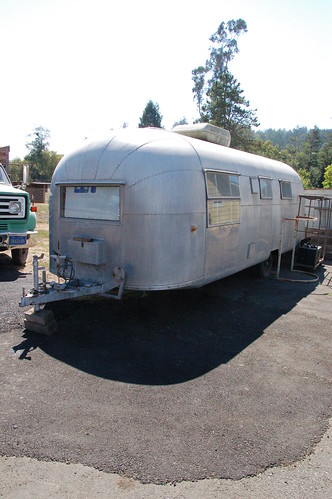
A typical Airstream. Photo by Jacob Davies via Flickr, used under the Creative Commons License.
It’s the little things…

William had a rough day yesterday. No, a seriously rough day. As he put it in one of his texts, “Bad karma morning. Way overheated. Had to walk away from it.”

As I understand it, it all started after he dropped me off at work. There was a huge crash on the 202 that left traffic at a standstill, so bad that the cops re-routed traffic through downtown Tempe. Getting home took three times longer than usual. Now William is a not-so-patient guy with a plan. He had things to do at home. Let me re-phrase that, he had a list of things to do at home. So, this put him “behind.”

As he arrived home, he noticed that Lotus (now nicknamed Killer Kitty for her hunting prowess) did not greet him outside as she usually does. This made William suspicious. As he entered the house he found a trail of feathers leading from the kitty door through the living room and down the hall into the guest bedroom. In the guest bedroom he found said Killer Kitty playing with one partially denuded pigeon, which happened to be alive as William discovered upon wresting it from Lotus’s mouth. The pigeon, much relieved and a bit disoriented flew across the hall into the shutters above Sage’s favorite sunspot where Sage was napping. Awakened by the flapping of wings, Sage leapt up and promptly began chasing the pigeon as it flew down the hall into the living room. By this time, Lotus had caught up and William was in hot pursuit. The pigeon perched and pooped on top of the entertainment center as the cats sat staring, plotting their plan of kill. William stood plotting his plan to get the pigeon outside where, in his humble opinion, the bird belonged. The bird, having its own opinion, flew into the laundry room and hid behind the dryer. I’m not sure which it was, feline or human, but someone flushed it from hiding and it flew onto the bookshelves where William finally was able to cover it with a towel and take it outside – after he locked the kitty door. His next text: “Kittys on house arrest.”

William, not to be taken off plan, began to get things set up so he could move the 31’ Airstream travel trailer from its current parking spot to another that would offer him more opportunity for shade as he worked on it and offer more space to park the truck. As he later explained, it took him “hours” to hitch the Airstream in the 112° heat of Phoenix in a truck that has no (zero, zilch, nada) air conditioning (yeah, really). Once hitched, William needed to pull the Airstream forward and back it up, negotiating around the orange tree into the new, highly sought-after parking spot. His next text, “Tried moving the A/S and creased the passenger front quarter. I am so pissed.” I phoned William to check in. He was not in a good place. There were many words I cannot put in print. He expressed his desire to use C4 (explosives for those of you unfamiliar) to blow up the Airstream.

Later William picked me up from work and during the tense ride to do a couple of errands (he was still not in a good place), I learned that not only did he dent the Airstream; he backed the truck into the accursed orange tree and shattered his passenger side taillight. Errands complete and driving home, William stated that he needed my help to get the Airstream parked because after his drama of the afternoon, he left the @&!^%#$ Airstream on the lawn. He needed to get this done that evening so he could let it go. I asked if he needed to do this before or after dinner. He said, “Before.” As I said, he’s a guy on a mission.

Home, in the now 108° heat, I found myself in the precarious position of offering a severely pissed off and hypoglycemic man directions not only on how to drive, but also on how to back up a 31’ trailer. Do you see my precarious position?

The first order of business was to extract the truck and Airstream from the accursed orange tree. Seriously, it only happened because God is good and the tree, fearful for its life, sucked its branches in a couple of inches to let the Airstream pass unscathed. Then onto the business of backing the Airstream into the glorified parking spot, which would allow for the very high priced commodity of shade in Phoenix. Around the orange tree (no longer accursed as it had cooperated with the extraction process) and next to the carport (which has a very pointy front corner of the roof that seemed to leap out in an effort to strike the Airstream – maybe it was a mirage from the desert heat), across the driveway, over the lawn, into the flower bed. Back and forth. Back and forth. Back and forth… Yeah, it took awhile. "A while" here is measured by the number of trips the Teach for America guys took to the dump as a result of moving in across the street: seven.

I went inside and began dinner while William cleaned up outside. By the time he came in and showered, dinner and a gigantic vodka tonic were waiting for him. We ate and he began to come around to himself. He apologized for being tense and harrumph-aly. He talked about how nothing seemed to go right during the day and how pissed he was about denting the Airstream. And how he was going to miss me because I was to fly out the next morning to attend a conference. We talked about my day and just hung out. A little later, while he watched a movie, I went into the kitchen and began to make brownies, his favorite. Done, so crispy on the outside and fudgey-gooey on the inside, I brought him a plate of brownies and gave him a hug. “Wow! “ He said, “Thanks. Chocolate is good!”

“Yup, you’re welcome Sweetie. It’s all about the little things. I love you.” He smiled and hugged me, “Love you too, Sweetheart. Thank you.”

Chain Reaction

By Lise Alschuler, ND, FABNO
AANP Past-President (2008-2009)

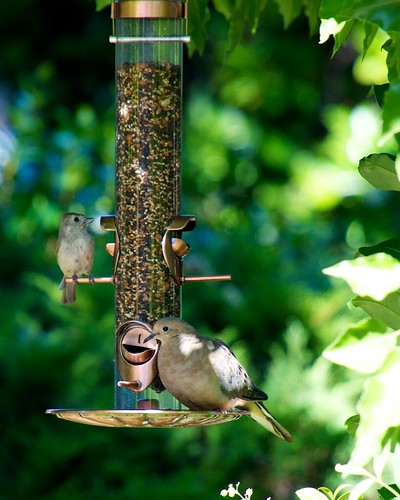
Photo by Don DeBold via Flickr, used under the Creative Commons License.
There is an interesting and, frankly, ear-splitting phenomenon occurring in my household. We love birds, so we installed a variety of feeders in both our back and front yards. We diligently fill the feeders as they are drained by hungry birds. Our efforts are worth it. We are treated to a plethora of warblers, wrens, finches, woodpeckers, chickadees, doves, and hummingbirds. The colors are spectacular and we grin with satisfaction at the busy chomping occurring outside of our windows.

We are not, however, the only ones grinning. Our neighbor’s cat now loves us, or rather our yard. Not only can he sit in-wait for a bird, but the seed droppings have attracted a variety of other delectable critters. We have what seems to be several families of chipmunks and squirrels that come to eat the discarded seeds on the ground. Unfortunately, the cat has made off with quite a few of these little ones.

And that brings me to Nora, our dog. Upon waking in the morning, after a good stretch, she eagerly trots out of the bedroom and hustles down the stairs. She gains momentum as she goes so that by the time that she reaches the main floor she is galloping towards the bay windows in our kitchen nook. With her tail a blur, she carefully scans the yard. She is usually rewarded with one, and then several more, chipmunks; and on a good day a squirrel; and on a particularly phenomenal day, the cat. She greets each one of these critters with a wildly enthusiastic barrage of barking, moaning, squeaking and (dog) talking. The bigger the animal, the louder she is. Unfortunately, our house has wood floors and minimal carpeting, so her barks bounce off the interior of our home with ear-splitting volume. Inevitably, after about 10 seconds of this cacophony, we command her to stop. She does, but proceeds to whine/talk/moan at the world on the other side of the glass. Exasperated, we often let her out on the porch where she barks her way into the upper hand and clears the lawn of all creatures – winged and tailed. And then there is blessed peace and quiet. She comes in content, we settle in, and soon the birds come back and it all starts over again.

Despite the fact that we are probably losing the upper register of our hearing, we just won’t take the bird feeders down. We recognize that we are completely responsible for initiating this chain of events and, as such, have no right to complain. It is a daily lesson for me too as I can’t help but wonder what other chain of events I have unknowingly or inadvertently set into motion. Wondering about that also gives me pause whenever I start to blame someone for something as I realize that there is very likely possibility that a long series of events, decisions, and situations led up to what I see before me.

Actually, just about everything seems to work this way – illness included. A sickness is usually the result of a long series of events, decisions, and circumstances. What we see manifested is the tip of a vast iceberg of interconnections. Perhaps, spending some time taking a look underneath would be a good idea, and certainly recognizing the ever-present connectivity in the world gives us deeper understanding and, ultimately, compassion.

Double Vision

By Bill Benda, MD, FACEP, FAAEM

Photo by Lomo-Cam via Flickr, used under the Creative Commons License.
“Visionary.” Now there is a word we’ve all heard countless times as we meander the naturopathic path. Merriam-Webster defines the term as “one having unusual foresight and imagination.” We tend to view our visionaries as those among us who can see into the future, imagine unimaginable realities, lead us to promised lands if we are intrepid and willing enough to follow. We laud our visionaries, follow their writings, award them at our banquets.

As we should, should we hold to that particular definition. But from my boundless perspective, and limited experience, a visionary is not necessarily a prophet or clairvoyant, but rather someone who can actually discern the truth of the present moment – a point of view requiring far more courage to express than any tale of potential future pleasantries. Visionaries who can discern reality are fewer in number than the prescient variety, and those with the courage to voice their views are fewer still, given the political price that must invariably be paid, because the reality of our culture -- and of our healthcare system, and of our profession -- is not always pretty, and definitely not as pretty as our conference and clinic brochures tend to proclaim.

Now do not misinterpret these words –- the underlying beauty of the naturopathic and holistic and integrative et al. philosophies and therapies is alive and well, and more than worthy of love and support. But we in our optimistic, energy-medicine, “hugs heal” mentality are often more than hesitant to take a long, hard look at our internal dysfunctions, dysfunctions that are an essential part of our very humanity rather than an unwanted and obnoxious uncle who has overstayed his welcome. We hold onto historical injuries that are no longer relevant. Our organizations avoid dealing with whispered dissent from their membership. Industry fails to note that their journal advertisements and promises of health are not that much different than those of the conventional brethren we condemn.

And why am I writing these words on this particular blog at this particular time? Because as an AANP board member and associate editor of your journals and adjunct faculty at one of your medical colleges, and especially as a non-ND, I believe your profession is at a crossroads, an adolescent-to-adulthood moment of your evolution when it is time to let go of the past and create a new future. And this shift cannot, and can never, occur without first making a difficult and objective assessment at what is real in the present.

So the next time one of your fellow professionals or employees or students or board members stands up and points out the pachyderm in the pad, see if you can refrain from withdrawing from the inevitable discomfort and instead take a long, hard look at the actual information being presented. You may well find that you have a bona fide visionary in the room.

Turbulence

By Lise Alschuler, ND, FABNO
AANP Past-President (2008-2009)

I was on a plane recently that, as it started its descent, encountered a snarl of air currents. As we were being tossed around, the copilot announced that we needed to buckle our seatbelts tightly and keep our trash out of the aisle so that the flight attendant had an unobstructed path back to her seat. He had to repeat the message because the bumps created such a stutter in this voice, it was hard to decipher. A few seconds after his second announcement, a blur hurdled down the aisle and landed in her flight attendant seat with a loud, “My, my!”

So there we all were, gripping our arm rests, fighting panic. With each especially hard bump, there were scattered exclamations or nervous laughter throughout the plane. Strangers who had not even acknowledged each other getting on the plane now turned toward each other with shared glances of worry and reassurance. As we finally cleared the turbulence and people relaxed, the plane was full of animated conversation – neighbor to neighbor.

As I collected my own breath and relaxed back into my seat, I was struck by how unifying that shared fear was for us all. We were all spectacularly humbled by this force of Nature wrestling with our plane. We were stuck in it together, and we bonded.

Later, happily on my own two feet in the terminal, I looked out at the sea of people walking past me and I slipped right back into my solitary traveler mode. As quick as my sense of community had developed, it evaporated. It all made me realize what a tremendous role we each play in each other’s lives – even in the lives of people we do not know. We each hold the potential to bond or to ignore one another. The potential to bond with each other is right there, lying in wait, ready to spring into action at the first provocation. It seems as though when we are in a situation that sheds our normally carefully constructed layers of insulation and protection and leaves us naked to our true self, what we find is a compelling desire to connect with each other. Connection is reassuring, orienting, and inspirational.

Makes me think that perhaps a bit of turbulence in our lives may not be such a bad thing after all.

The Unlikely Partner

By Christine Girard, ND
2010 AANP Physician of the Year

Photo by patti haskins via Flickr, used under the Creative Commons License.
I went to the pet store to buy cat food for Sage, my perfect, 17-year-old, part-Maine coon cat. As I walked into the store, I saw a few cats in crates that were on display from the local shelter. I see this each time I enter this store. But that day…heavy sigh... that day, a small black and white cat made eye contact and turned over exposing her belly. I was strong. I walked by. I went to the back of the store to the cat food aisle to choose Sage’s food. I would not be suckered by a pink and white belly. I walked to the register – well, I almost made it to the register. I detoured to the cat crates. Three cats in separate crates. Two slept. One chirped and pawed at me through the plexiglass window. I texted William, my Sweetheart, with her picture. His response was something in the realm of “Are you out of your mind?”

Once home, I teased about adopting another cat. William and Sage both tolerated my teasing. This went on for a week. At that time, I bought more food for Sage at the same store and saw the same black and white face peering through the plexiglass. I texted more pictures. The manager of the store said that usually the cats are adopted within two weeks. “They have a really good turnaround time,” she said. I didn’t know cats had a turnaround time. Who knew? Reasonably assured, I went home.

I conveyed this information to William, who continued to tolerate my random musings about having another member of the family. Sage offered the occasional rolling of the eyes (didn’t know cats could do that, did you?). William by this time had asked that I cease and desist. The following week, I found myself dreaming about this cat. I couldn’t ignore her. I explained this to William. What I love about William (well, one of the things) is that he listens. I mean he really pays attention and listens. That week William went to the store to buy Sage’s food. He texted me that the black and white cat was still there. What should we do? She had been there for longer than the two weeks. I had been dreaming about her (and having private conversations with Sage about having a little sister). We couldn’t ignore her.

So, by phone, I walked William through what needed to be bought and I prepared our guest bedroom for the new cat. Sage slept. He woke later that afternoon and his world had changed. He sniffed at the guest bedroom door and hissed. Not an auspicious beginning.

Over the following few weeks, we introduced them to each other. It has gone remarkably well. Sage has been generally tolerant, and our kitten has been the annoying little sister he never wanted.

We named her Lotus because she has the pinkest nose and the pinkest belly under white fur. It reminded me of the blush of pink on a white lotus flower.

What has been unexpected is her effect on my morning yoga/meditation. She comes in the meditation room and watches intently as I light the candle and incense. As I arrange myself in lotus position, she waits patiently. Once I begin to focus, she steps into my lap, arranges herself and purrs. She just sits there quietly. Lotus in the lotus position. What I have found is that I am more motivated to meditate because I have this unlikely partner who shares this very special quiet space with me. It really is quite precious.

Holiday Cheer in Trying Times


By Lise Alschuler, ND, FABNO
AANP Past-President (2008-2009)
Photo by CCAC North Library via Flickr, used
under the Creative Commons License.
‘Tis the season to be jolly! … A whole season to be full of joy, conviviality, glee and laughter.  I reflect on that as I think about two patients. One is an extremely vivacious, fast-talking, go-and-get-‘em young woman diagnosed with ovarian cancer. She concluded integrative therapy early this Fall. She felt great and her motivation to continue to live healthfully was strong. She even took her mile-a-minute self into a Tai Chi class and is learning to love the peaceful gracefulness of this exercise. And then, a follow-up scan just before Thanksgiving found several new tumors in her liver.  Just after Thanksgiving, she began a new round of chemotherapy. She understands that her that her prognosis is guarded and yet, her jolliness has not diminished in the least. She ends every email with a salutation of love and gratitude. She wishes her providers good health and happy Holidays. Her sense of exuberance in daily living continues to reverberate in her being.
The other patient is a woman that I have had the honor of providing naturopathic care to for the past 2 years.  She was diagnosed with triple negative breast cancer with an inflammatory breast cancer component. This is an ominous diagnosis, to say the least. Over the past two years, she has had sequential chemotherapy, surgery and radiation therapy. She has also maintained a comprehensive regimen of diet, exercise and supplements. She has exemplified health and radiance throughout her treatments, amazing all of her care providers. In September, she was without evidence of disease. Then, the week after Thanksgiving, a follow-up evaluation revealed metastasis in her bones and more inflammatory breast cancer. Upon hearing what, for most people, would be a devastating blow, she absorbed the news and, as she put it, “picked up the shattered pieces of myself and got right back into the saddle.”  She too, continues to shower her care providers with gratitude and well-wishes. She understands the seriousness of her situation and, at the same time, has managed to focus on the opportunities, the hope and the love around her.
For me, these two courageous women personify the true meaning of holiday cheer. They have taken being joyful and jolly to a whole new level. They are giving life a big bear hug and are squeezing every drop of its vitality into their attitude, communications, actions and ultimately, into the lives of those around them.  So, in the spirit of the season, and with deep love and admiration, I thank them for their splendor. 

2010 Year in Review

By Carl Hangee-Bauer, ND, LAc
AANP President

The AANP turns the page on another year. Image by andy.brandon50 via Flickr, used under the Creative Commons License.
As we approach the final days of 2010, I find myself in a reflective frame of mind, looking back at the past year as well as ahead to 2011 with hope and anticipation. Personally this represents my halfway point as AANP President. It’s been an active, exciting and challenging journey so far, and my suspicions have been confirmed that being in this position in the AANP is an opportunity for growth. I think all of my fellow officers and Board members past and present would agree.

The Board and Staff have just completed the work and budget planning for the next two-year cycle and it has made me think about the present state of the AANP and naturopathic medicine.

The AANP is in a very good place. Unlike many associations struggling in these economic times and tapping into their reserves to continue to function, the AANP ended the year with a balanced budget. We are living within our means, in no small part due to the vigilance and management of our executive director, Karen Howard. The AANP is fully staffed as we close out the year, having hired a new marketing and membership associate (Mandisa Jones) and state government relations director (Eugene McGill). In the coming year you will see more resources dedicated to state licensing, inclusion in the federal healthcare system, and benefits to support our membership, among other things.

The AANP Board continues to grow and evolve. This month we say “au revoir” to our departing board members Lise Alschuler, Michelle Clark, Bill Benda, Tabatha Parker and Sara Thyr. We thank you for your service and dedication to the naturopathic profession and wish you much success and happiness as you move on to other opportunities and challenges. On January 1, 2011, we are welcoming Holly Lucille, Joe Pizzorno, Carrie Runde, Keri Marshall and Cindy Breed to the Board as they begin their two-year terms. We are very excited to welcome these new members who bring a wealth of experience and willingness to serve the association and profession. Michael Cronin begins his term as President-Elect in 2011 and is taking on a greater leadership role within the Board as he prepares for his presidency.

As a profession, I believe that naturopathic medicine is in a better position to “take off” and serve more people than perhaps it has ever been. More states are on the cusp of licensure and, with the help of Gene McGill, I hope to see new licensed states soon. We are making inroads on Capitol Hill as Congress and regulatory agencies begin to implement healthcare reform, and I look forward to seeing ND inclusion in federal programs including loan repayment opportunities. Our DC FLI event in May is growing every year and we are now known in D.C.

As I write this it appears that CNME will be re-accredited by the US Department of Education for the next 5 years, the longest time allowed under the rules. Enrollment in the naturopathic medical schools is growing with plans for new schools in the next few years, and more NDs are graduating and bringing naturopathic medicine into their communities. Science and research opportunities are increasing with new NIH grants awarded to ND researchers, and the founding of Naturopathic Physicians Research Institute (NPRI), led by Carlo Calabrese, which will focus on developing studies to examine whole-practice naturopathic care. The Naturopathic Post-Graduate Association (NPGA) is up and running, coordinating residency opportunities amongst the colleges to increase the number of residencies offered and matching residency sites with candidates to improve the residency experience.

Our state naturopathic associations are becoming more sophisticated and active, developing marketing as well as continuing education programs to serve their membership. Better communication and coordination between AANP and state associations is occurring. Rick Marinelli, ND, was recently appointed to the Institute of Medicine (IOM) committee on advancing pain research, care and education, the first ND on any IOM committee.

So 2010 has been a good year for naturopathic medicine and the future looks bright. We have much to be thankful for as we take stock of 2010 and look forward to 2011 and beyond. As always, it comes down to the people who make things happen and the relationships we form—with each other, our patients, other like-minded groups and organizations, our local, state and federal representatives, and so forth.

YOU are the AANP; YOU are the profession. Everything the AANP does is filtered through the question: How does this serve our membership? As 2010 comes to a close, I want to thank everyone reading this for all you do, great and small, as every step moves us that much closer to realizing our dreams and goals for our profession and for the health and vitality of the communities in which we serve.

Have a joyous holiday season and a healthy and prosperous 2011.

Humility

By Lise Alschuler, ND, FABNO
AANP Past-President (2008-2009)

Photo by a.drian via Flickr, used under the Creative Commons License.
I have come to believe that it is very hard for doctors to be truly and authentically humble. Our days are typically filled with instructing others in various ways that they can tame the unruly pathways of disease. We are, in effect, attempting to exert our control over illness. We may refer to this process more gently as empowering our patients, but, even still, our attempt at dominion over illness remains an integral part of these empowerment efforts.

This force that we exert requires that we declare unspoken allegiance to our underlying beliefs and understandings about illness and about health. And holding this allegiance together is our ego, which, with any investment of attention, quickly becomes an attachment. Here is where things get dicey. Our attachment to our ideals about healing can blind us to other possibilities, and can make us feel overly confident in our direction and position.

I would go so far as to suggest that every healer worth her salt has displayed this ego-driven behavior. It seems a natural consequence of having the will to attempt to heal. Nonetheless this determination, while perhaps necessary at times, will ultimately impede our effort. When we start to lose that edge of wondering whether what we have recommended is actually the best recommendation, or when we find ourselves talking a lot more than the people seeking our care, or when we find ourselves feeling bored or uninspired, or when we start treating diagnoses instead of people – we have succumbed to our egos. We have lost our humility in the face of disease. With that, I suspect that the healing that we each uniquely offer when we are fully present and compassionately attentive is muted, if not mutated.

I think that Bill Mitchell, ND, may have had it right when he spoke about us as being our most powerful medicine – if we don’t get in our own way. True humility - with each other, our patients and, yes, with disease, too – affords us the best opportunity to support the Vis and allow healing in.

The End of the Innocence

By Bill Benda, MD, FACEP, FAAEM

Photo by tibchris via Flickr, used under the Creative Commons License.
Yes, the time has come. After four captivating (and at times interminable) years, the “let’s let an MD on the Board” experiment has come to its predetermined end and the data has been analyzed. The following is my technical report:

It was very interesting.

It was interesting to learn that our commonality was actually based more upon similarities in personality and style then clinical expertise or professional ideology. Idealistic, aggressive, principled, paranoid, outspoken, insecure, clear on others’ shortcomings but in denial of our own, tilting at windmills to save the world – naturopathic medicine has been more a mirror of my own life than anything allopathic medicine has had to offer in 35 years of practice.

It was interesting to discover that our future lies in fact upon the shoulders of our students, and not in the posturing and proclamations of those who claim to really, really know what is best for us.

It was interesting to feel the buffeting between the forces of science and intuition, observing the quick footwork as “evidence-based medicine” shuffles to keep up with the fact that evidence constantly changes with the analytical tides, while intuition remains an immovable constant that no academic text or research submission can ever hope to emulate.

It was interesting to experience the unceasing anger and derision directed at my own professional heritage, allopathic medicine, partly deserved in your struggle for equity, and partly an old story somehow needing to be retold within every conference hall or blog conversation.

It was interesting to feel like a father at a birth, not really allowed to get my hands into the actual delivery, but still knowing I had something to do with the blessed event, even now as I cut the cord.

It was actually far more than simply interesting – it was exhilarating, and painful, and fulfilling, and empty, and all the things we feel when we really do commit to a relationship knowing full well that it will someday come to an end. But of course I cannot hope to write of these things and expect they will be allowed in print, so I will leave this at goodbye.

So goodbye, dear naturopaths – I leave you in mostly good hands, grateful for the time that I have had with you, and how my life is the better for it. Goodbye to my fellow board members past and present – hopefully you have grown as I have, but with a fraction of the irascibility and frustration. Goodbye to Karen and David and Jan and all who have dedicated your emotional lives to this profession – you can still call on me to be your hit man from time to time if you find you just can’t pull the trigger yourselves.

Goodbye. Another adventure awaits . . .

The One True Way

By Bill Benda, MD, FACEP, FAAEM

Image by Nick Bygon via Flickr, used under the Creative Commons License.
Tunisia, Egypt, Yemen, Bahrain, Libya - what a wild month February has brought to the area we call the Middle East. What began as a singular objection to dictatorial rule has been spreading like a desert wildfire, and as with such conflagrations, holds both the potential of destruction and the promise of new growth from clearing out old deadwood. What is notable to those of us living half way around the planet is the undercurrent of excitement we feel with each passing news report of populist demonstration, triumph, and, possibly, democracy. Our uniquely American system of government may soon take root in a land of perpetual unrest and war, freeing the populace to seek the freedoms and capitalistic success we have come to enjoy.

Or likely not.

One of the idiosyncrasies of a privileged society is tunnel vision – if it works for us, it must be the best for everyone. Our old ally Sir Winston Churchill remarked, “democracy is the worst form of government except all the others that have been tried.” John Adams? “Remember, democracy never lasts long. It soon wastes, exhausts, and murders itself. There is never a democracy that did not commit suicide.” And of course, George Bernard Shaw: “Democracy is a device that insures we shall be governed no better than we deserve.” So why am I talking about this on the AANP blog?

Because I’ve noticed over the past few years that we in the “integrative” field tend to believe that ours is the “one true medicine,” depending of course upon what our chosen field happens to be. Naturopaths believe naturopathy is. Holistic MDs believe holistic medicine is. Homeopaths believe homeopathy is. As with religion – Christians believe Christianity is the one true faith. Muslims believe Islam is. Hindus believe Hinduism is. Buddhists believe nothing is. Isn’t what we personally believe the One True Way?

Likely not.

Our way, whether political, or religious, or medical, is not at all best for everyone else. But you would not know this from attending political campaigns, or church services, or annual conferences of any of the aforementioned guild organizations. And the primary problem with our devotion to our own profession is the irresistible urge to convert others, patients and practitioners alike, to our perspective, an urge that results in uncountable energies devoted to rehabilitating the unbelievers (always a failed strategy) rather than in creating continuity and tranquility within our own chosen, flawed system. And eventually we waste, exhaust, and murder ourselves.

Egypt and her extended family of repressed countries may not become democracies, but they will become what they choose or are forced to become, whether socialist, parliamentary, or remaining monarchies or dictatorships. American health care will likely not become holistic, or naturopathic, or integrative, but it will not remain allopathic either. It will become what it will become via known and unknown forces. The key for us is to not worry so much about how we can fix everyone else’s blindness to our perfection, but about how we can fix our own little professional realms. Are our students happy? Are our members heard? Are our leaders leading? These are the questions we need to pursue, beyond “are we evidence-based?” or “can we get CPT codes?” The latter questions hold definite merit, but need be servants to the former. Because the One True Way is always inward.

Reflections from the Board of Directors

By Sara Thyr, ND

Bastyr University. Copyright © 2010. All Rights Reserved.
I was in Seattle in November for my last meeting with the Board of Directors of the AANP. It was an unusual mix of emotion for me. I have felt ready to be free of the substantial time commitment for some time now, but felt the melancholy creep in well before the end of the meeting.

The largest change in the years that I have been on the Board is moving from a reactionary board to a visioning board. Rather than putting out fires and throwing money at the crisis du jour, we are looking into the future and planning in a way that can only benefit the growth of our profession.

All of the governance documents are available for your perusal on the AANP website (you must be logged-in to view). If you haven’t already seen what we’ve been up to for the last few years, it will be worth your time to take a look. Your voice and involvement in your national association makes it all work. It should be evident from the ends and measures that we have set forth that we do this work for everyone in the profession (actually, everyone in need of healthcare in our country).

Looking at the future and where the Board sees the profession down the road is quite exciting. Everyone in the United States will know what a naturopathic physician is and have the opportunity to utilize naturopathic medicine for their healthcare. Can you see it?

I went to school at Bastyr University and graduated over 10 years ago. Being back on campus and seeing how it has grown in the years I have been gone was incredible. We stayed in the “village” – the LEED-platinum certified dorms on campus. They are beautifully designed and a much-needed advancement over previous dorm life. The herb garden has emerged to be a fixture on campus that is quite a bit more than the little circle of plants that was started when I was there. The students have more tools to study anatomy and other topics. Even though we were just there on a weekend, it was evident that much has improved. And with that growth and change will come great leaders in the profession. Not only do we have a student Board member, but we also had the President of the NMSA (Naturopathic Medical Students Association) present. With their input we can move towards better tools for graduates and our profession. The AANP Board will continue to grow, visioning and leading the profession with the best, most adapted tools that we and our staff can conjure.

The level of reporting on processes, the work plan, the budget and how well we are meeting our goals has substantially improved with changes and additions to the AANP staff over the years. The involvement in state licensing has increased and the connections for all legislative efforts have improved since my earliest days on the Board, largely thanks to the work of Executive Director Karen Howard, lobbyist Jan Lipson, outgoing Board member Michelle Clark, and now, our new legislative liaison, Gene McGill. Let’s not forget the countless volunteers in every state who work exceptionally long hours in order to make it all happen and improve our profession.

What will I miss the most about the being on the AANP Board? Well, I have had the great pleasure of serving with some truly remarkable people in our profession. In my experience from working at the state level from New Hampshire to California, I know of no other profession who has so many brilliant, caring and committed leaders. So I will miss being around these great minds, working arm-in-arm with them, and seeing that powerful impact we can have on the future of naturopathic medicine when we roll our sleeves up and move towards our goals.

I know that I leave the Board in capable hands. It is an exciting time to be involved and to see our profession expand its reach, just as the Bastyr’s herb garden expanded its reach. But as the last minutes of the meeting rolled by, I found myself just a little bit glum that it will be my last one for some time.

The Future of the AANP

By Carl Hangee-Bauer, ND, LAc
AANP President

Fall has been a busy time for the AANP Board. After the dust settled from the convention and things relaxed for a bit, attention turned to identifying goals and priorities for the 2011-2012 work plan and budget.

Sounds exciting, huh? Actually, it’s some of the most important work that the AANP Board does. It requires that Board members think strategically, surveying the landscape for political and social trends, considering the future of healthcare reform, understanding readiness in states close to licensure, listening to feedback and the experience of our naturopathic physician members, and bringing that back to the table as we discuss and deliberate.

While the Board discusses these topics throughout the year, the formal start to our planning began at the August Board meeting. We examined programs that are currently underway and ranked programs such as marketing and public relations, state and federal affairs, fundraising, and others in order of importance to the ends and the goals of the AANP. The staff, led by Karen Howard, took this preliminary feedback and constructed the first draft of our next 2-year work plan and budget, getting further feedback from a Board survey that took a closer look at these initial ranking and programs.

This past weekend the Board held its Fall meeting on the beautiful campus of Bastyr University. Most of our time was spent discussing and debating the various details of the proposed 2011-2012 work plan. All of this, by the way, is done with keen attention to how to best serve our membership.

Let me give you some insights of the Board approved work plan.

Far and away the biggest priority is directed toward membership issues such as member benefits and professional success, programs such as the convention and membership services, and tools and resources for membership support including the AANP website.

State and Federal Affairs are a very big piece of the work plan. Facilitation of licensing in more states, inclusion in federal programs for the naturopathic profession under healthcare reform, engaging in strategic partnerships with like-minded organizations to effect change, and training our physicians and naturopathic students at the DC FLI – all are pieces in this very complex work.

Next, our Executive Director will take the work plan and assign budget categories to each area of emphasis for Board review and approval. This will be a very challenging step. While the AANP has weathered the economic downturn quite well compared with other associations, the economy has nonetheless impacted us. The budget will be very tight, and it will be a challenge to meet all of our goals. It is likely that choices will have to be made based on the key goals, priorities and programs we’ve identified.

I tell you all of this so you can understand some of the work that goes on behind the scenes and see why it is so important to be a member of your national association. The AANP is a member-driven organization that represents you in the halls of Congress and to the American people. It supports state licensing efforts and facilitates communication amongst various organizations within the naturopathic profession. It supports research and data collection to better inform others of our work. It provides top-notch continuing education with many of the thought leaders of our profession. It brings unity to our community of doctors and students in every state in the US and other countries.

Please join us as we move into the future by joining or renewing your AANP membership and letting your voice be heard.

Alley Jelly and Modern Chemistry

By Jacob Schor, ND, FABNO

Photo by Rachel Tayes via Flickr, used under the Creative Commons License.
There is a Hebrew prayer that expresses gratitude after tasting the first fruit of the season. This morning I am wondering whether there shouldn’t also be a prayer for the last taste of the season. I think this as I toss our last sprig of fresh basil into a pan of hot olive oil and the kitchen fills with the odor. The basil is in competition, though, with a pot of applesauce; I’d collected golden yellow apples that last night’s wind knocked off the tree around the corner. With the clock’s dropping back over just two weekends ago, there’s room in my morning schedule to make pack away a jar of applesauce before leaving for the office.

The weather here in Colorado collaborated to produce a bumper crop of fruit here in Denver. After watching cherries, apricots, plums and apples compost on the lawns of neighbors who have neglected to harvest their bounty, I’ve taken it upon myself to save what I can. Poppy also has taken advantage of the apples especially, and insists on eating a stomach full each day.

My wife Rena and I have been making grape jelly on weekends with some of the most flavor-filled Concord grapes I can even recall tasting. Thus the last few weekends have found me gathering the grapes hanging into an alley just off Montview Boulevard. This has led me to the grocery store, and to start experimenting with the new forms of pectin available. No doubt some reader will write to tell me that I shouldn’t use these modified pectins, but at this point, in my ignorance, they are very exciting. Traditional jelly-making required very high sugar concentrations to set. If I recall correctly, one heated the jelly ‘broth’ to about 220 degrees Fahrenheit, a temperature at which the mixture was about 65% sugar. Without the high sugar concentration, the jelly wouldn’t set. It had to be sugar; the pectin wouldn’t jell if you tried substituting honey.

Times have changed and food chemists have developed pectins that don’t require added sugar and will still jell if sweetened with honey. This is why you can buy sugar free jelly and preserves in the grocery store. We made our first batch of grape jelly the old fashioned way, making juice from the grapes and cooking it down with what seemed an enormous amount of sugar. Our second batch is still setting, but we made it without adding any sugar. I’m quite looking forward to opening the jar for my first taste in a few weeks.

An excellent discussion of how to make no sugar jellies is available from the University of Tennessee’s Agriculture Extension Service: www.utextension.utk.edu/publications/spfiles/SP325-F.pdf

This leads me to the point in this blog piece when I turn on my computer’s link to the National Library of Medicine and look up some current scientific data linked to whatever I am ruminating upon.

It so happens that there is a new paper looking at the effect of drinking Concord grape juice on blood pressure published a just over a week ago.

Researchers at the Boston University School of Medicine, almost within sight of Concord, the town where the grapes are originally from, conducted a placebo-controlled trial of grape juice in mildly hypertensive individuals. This was a double-blind cross over study. 64 otherwise healthy people participated and drank either grape juice or a placebo for two months, took a month off, and then switched beverages.

Although no statistically significant difference in average blood pressure was measured, several endpoints of interest did change during the grape juice portion of the study. Night-time blood pressures dropped 1.4% while drinking grape juice, while they increased 2.3% during the placebo phase. Blood sugar decreased 2 mg/dL while drinking grape juice, and increased 1 mg/dL during the placebo phase.i Interesting, but not fascinating.

These results are different from an earlier study from 2004. In this earlier study that was conducted in Korea, systolic blood pressure decreased an average of 7.2 mm Hg (p = 0.005) and diastolic blood pressure average by 6.2 mm Hg (p = 0.001) at the end of 8 weeks.ii In the new study. participants drank 7.5 ml /kg body weight, while in the older study, 5.5 ml/kg body weight was consumed.

Could the grape juice polyphenol content have varied, or could there be some genetic variant that differed between populations? It’s not clear.

Whatever the case with these studies, I remain enchanted with the idea of making sugarless jams and jellies, and look forward to next summer’s possibilities already. And as far as my pondering the lack of a prayer for the last of the season, well, it’s obvious that wiser ones than I understand that one never knows which taste will be our last so that all that we can mark is the first.
____________________________________________
i Dohadwala MM, Hamburg NM, Holbrook M, Kim BH, Duess MA, Levit A, Titas M, Chung WB, et al. Effects of Concord grape juice on ambulatory blood pressure in prehypertension and stage 1 hypertension. Am J Clin Nutr. 2010 Nov;92(5):1052-9.
ii Park YK, Kim JS, Kang MH. Concord grape juice supplementation reduces blood pressure in Korean hypertensive men: double-blind, placebo controlled intervention trial. Biofactors. 2004;22(1-4):145-7.

Resilience

By Lise Alschuler, ND, FABNO
AANP Past-President (2008-2009)

Photo by OakleyOriginals via Flickr, used under the Creative Commons License.
I have a dear friend who is 71 years old and as spunky as they come. She is intensely inquisitive of everyone who has the good fortune of meeting her. With focused determination, in a matter of minutes, she can extract the most intimate details even from the most reticent person. At the same time, she has a constant twinkle in her eye and a belly laugh ready to erupt at any moment. She is entirely unreliable at making plans as something better is quite likely to come along and catch her attention.

Around a table filled with her friends, she loves to debate the deeper meaning of every movie that is showing within a 20 mile radius. At one of these dinner gatherings a few days ago, I asked her a question, “What do you most attribute your good health to?” Her response: “My good health is the most certainly the result of surviving all of my bad habits.” Perhaps she was referring to her daily evening bourbon cocktail. Perhaps she was referring to her disdain for structured exercise. She does have a few bad habits to be sure, but as the evening progressed, I wasn’t thinking of those.

I watched her listen to her friends with complete compassion, while gently and persistently pointing out the silver lining in every cloud that someone resolutely created and simply delighting in the joy of being with people she loves. I thought about her past, too, and the deep adversity and loss she has experienced. It dawned on me that the real secret to her health and vitality was resilience – her unceasing ability to rebound from all manner of disappointments and to emerge into a confident embrace of life within and around her.

Her resilience seeps into those around her as she constantly buoys them up, praises them, and revels in their unique brilliance. You just cannot help but to feel better about yourself when you are with her. She lives life with the expectation that we will swing at anything that life throws at us, that we will make contact with the ball, and that the point is to revel in wherever the ball flies. I smile as think of her now, likely snuggled into her bed, watching one of her favorite shows on TV, eager to fall asleep so that she can start her day tomorrow.