Showing posts with label integrative medicine. Show all posts

Welcome to the Party

By Bill Benda, MD, FACEP, FAAEM

Photo by LS Lam via Flickr, used under the Creative Commons License.
I spent this past weekend at Southwest College of Naturopathic Medicine, where I teach a 50-hour emergency medicine course to students who must sit there and wonder, “Why am I learning this stuff?” But today’s rant is not about conventional vs. alternative or botanical vs. pharmaceutical, but about a more pervasive political movement apparently sweeping the country and, yes, our own little naturopathic family.

I often break up the classroom monotony of trauma and myocardial infarctions and wound closure with philosophical diversions – public policy, healthcare reform, influence of the neutraceutical industry on medical education, and such. But this past weekend we talked a bit about the Tea Party, and how its not just for mainstream politics anymore.

You see, this strange wave of populism that has taken us all by surprise is lapping at the shores of our particular profession as well as flooding the red and blue bastions of conservative and liberal thinking across the land. As an MD, I have limited interest in such important clinical ND issues as CPT codes and scope of practice – these simply do not impact my personal life. But I am fascinated by the internal politics of this field and the personalities that nudge and pull on the ship of naturopathic medicine like tugboats, each chugging towards its own desired destination. And what I see in today’s political horizon is our own little populist movement announcing unhappiness with the status quo and calling rather insistently for that nebulous yet ubiquitous concept of change.

What kind of change is, as with the rest of the country, still a bit nebulous and undefined, but we will let this detail work itself out over the ensuing months. The fact is that, as an AANP Board member for the past four years, I have been able to identify and get to know a few of the players and a few of the issues. The AANP, its Board, its executive director, the state associations, their Boards, their executive directors, the schools, their presidents, past AANP presidents, future AANP presidents, journalists (including myself), the Academic Consortium for Complementary and Alternative Health Care (ACCAHC), the Integrative Healthcare Policy Consortium (IHPC), the Naturopathic Coordinating Council (NCC), the Naturopathic Medical Student Association (NMSA) and on. And on. Tugboats pulling and pushing on the good ship Naturopathy. Stay the course. Change direction. Return to the past. Dive into the future. Toot toot.

Before any of the above mentioned begin to take this analogy a bit too personally, I wish to make one point quite clear: This is all a very, very good thing. Should we take a look at our national political system as a larger illustration, I believe we must come to the conclusion that no matter our individual views on the Tea Party movement and its leaders, we cannot but admit that our current political system has become mired in dysfunction and inertia, and it may well take an entity as disruptive as the Tea Party to shake some sense into us. In the same vein, I believe it is time for the profession of naturopathic medicine, at the national, state, academic, political, media, and individual levels to take a long, hard look at our own dysfunctions and inertia (We all have them! Yes we do!) and come to a communal course of, well, change. Naturopathy is no longer under the social and professional assault from that it was twenty years ago. Conventional medicine is no longer the ogre trying to eat our children (well, maybe the AMA might still be). We must put past thinking where it belongs – in the past.

So change is in the air, as it must be. But we must realize that change does not mean returning to past thinking, or past policies. It does, however, require transparency and openness on the part of those instigating change. Personal agendas have no place here, and will serve only to create further dysfunction and inertia. Unfortunately for me, I will no longer have a front row seat after December 31st, when my Board term expires.

But I’ll be watching from the sidelines nonetheless . . .

You Like Me, You Really Like Me

By Bill Benda, MD, FACEP, FAAEM
2011 Naturopathic Champion Award Winner

Dr. Benda accepts the Naturopathic Champion Award at the 2011 AANP Convention Gala.
I received an award at August’s AANP annual convention at the Biltmore, a brand new one entitled the Champion Award, which from this time onward will be given to a non-naturopathic individual recognized for his or her contributions to the field. It was a bit of a bittersweet moment, for a number of reasons, which, in my semi-shocked and semi-intoxicated state, I revealed to the gathered audience of several hundred.

You see, since the end of my second term on the AANP Board this past January, I have been contemplating my interprofessional affair with naturopathic medicine. I’ve come to realize that this relationship has followed the course of most of the intimate personal romances I’ve wandered through during my adult life: the shy, hesitant initial contact; the heady discovery of mutual interests; flirtations via email; commitment to a two-year trial, followed by another. The inevitable red flags, mixed messages, minor jealousies, extraorganizational dalliances, threats of abandonment. And finally, that inevitable choice to be made as we separate: Can we still be friends? If only for the children?

But more on this in a minute.

Back to the award presentation. After Sally LaMont came to my table and explained that I really had to step up on the stage and say a few words, I made my way to the microphone and, given that I had no clue and therefore no opportunity to prepare, had no other option than to blurt out what I had been thinking just minutes before.

I revealed that I had spent that particular day in my hotel room on the bed watching bad television and figuring out how to extricate myself from the evening gala without too much notice. How to weather the emotions that arrive whenever a relationship changes. I actually revealed to the audience that whenever I’ve thought of naturopathic physicians over the past decade I’ve felt a combination of a “deep love and a desire to kill you.” Really, I said that. It came from years of appreciation of brilliance and commitment, as well as exasperation with avoidance of dealing with internal issues. The irony of helping a profession with such beautiful and pure principals while constantly hearing about the evils of my own chosen vocation. The puzzled looks when I brought up my frustrations to my fellow Board members, as in “What are you talking about?”

Ah, well. The good news is that we will still be friends, especially for the children, as I get to continue working with Naturopathic Medical Student Association leadership knowing that they will be college deans and presidents and AANP officers and Board members in just a few years. And that I can still maintain some sort of contribution to our health-care system outside of the daily grind.

And there is something else I said on that stage that I know to be true, and will always believe to be true. Something I’ve preached and written and lectured about and sort of made my own personal integrative crusade. And that is that, when we get down to it, there are no MDs, or NDs, or RNs, or DOs in this world. No titles, no social standing, no one-upmanship. There are simply people who have chosen a particular path in their desire to help their fellow human. It is, I believe, how some of us choose to manifest love—not something we feel, or express through song, or poetry, or touch. Love is simply what we are, and it is made manifest in all of its beauty by what we do when another needs us to act on their behalf. It is this—not the money, or prestige, or social conscience—that makes the insanity of working in such a dysfunctional system tolerable. And makes living such a complex and, at times, such a painful life end up being worthwhile.

So thank you, everybody. I like you, too.

'Til Death Due Us Part

By Bill Benda, MD, FACEP, FAAEM

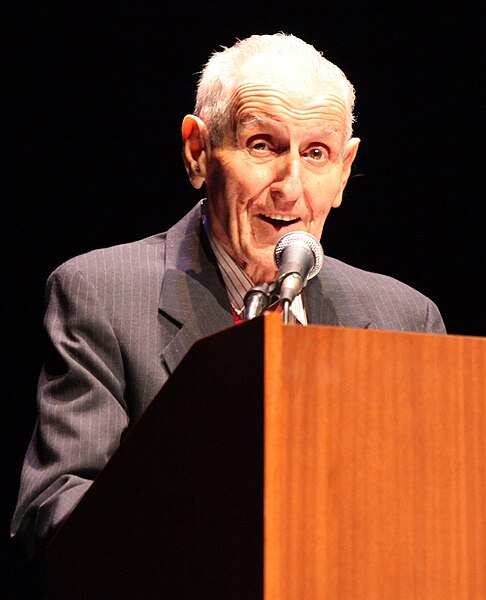
Dr. Jack Kevorkian speaks at UCLA in January 2011. Photo by Halebtsi via Wikimedia Commons.
Dr. Jack Kevorkian died last Friday in Royal Oak, Michigan, from pneumonia and kidney failure. If you will remember, Kevorkian defied prosecutors and the courts to help terminally ill patients end their lives at times of their own choosing, and paid for his work with eight years in prison after being convicted of second-degree murder in the death of the last of the more than 100 patients whose suicides he assisted.

So why is such ancient history relevant to us today? Because the fact is that our unprecedented longevity, courtesy of medical technology, often brings with it incalculable pain to patients, families, and the collective economy. I clearly recall the doctor-as-god mentality of the 1970s and ’80s, with white-coated knights heroically battling death by whatever means available, unaware of and unchallenged by the wishes of the afflicted patient. This mindset has not disappeared from our professional ethic, as we find ourselves compelled to combat the incurable cancer, tube feed the severely compromised newborn, or pump the heart of the nursing home patient whose time has come to stop beating.

So where does the integrative medicine community stand on this issue? I am not aware of any research, educational conference, or journal article that has engaged our attention and conversation on the topic of facilitating another’s desired death. Dying a good death, yes. “Dying healthy,” our integrative goal for the terminally ill, that too. Reincarnation, survival of consciousness, illness as teacher, wounded healers; all discussed, explored, philosophized, and meditated upon. But not the uncomfortable social issue of actually helping another to end the journey of living. We strive to be in intimate partnership with our patients, sharing in their spiritual path as well as caring for their minds and bodies. But how should we respond if asked to participate in alleviating another’s torment through an ultimate act compassion? Or is it felony? Does our holistic philosophy lean either way? Or do we hesitate lest the wrath laid upon Jack Kevorkian visit our young and vulnerable profession?

With baby boomers heading over the hill like lemmings in the next few decades and Alzheimer’s predicted to be epidemic by the year 2020, it is time to clarify our professional stance on this issue. I personally believe that we serve each patient best by respecting their authority over what is to be their last earthly act, yielding to them ultimate control over what has become their last earthly possession. Of course the topic is fraught with legal, political, and moral jeopardy. But I am certain that this is a conversation whose time has come, a time to grapple with our responsibility to facilitate both a good life and a good death for our patients. Kevorkian’s advocacy for the right of the terminally ill to choose how they die is widely credited with sparking a boom in hospice care in the United States, encouraging physicians to become more sympathetic to their pain and more willing to prescribe medication to relieve it. We should do no less.

President's Message: Advocating for Naturopathic Medicine

By Carl Hangee-Bauer, ND, LAc
AANP President

American Medical Association headquarters in Chicago, IL. Photo by Steve Silverman via Flickr, used
under the Creative Commons License.
It’s been quite a busy time over the past few weeks, with trips to Washington, D.C., and Chicago to educate and advocate for the naturopathic profession.

2011 DC FLI

In late April, I flew to Washington to spend three days at DC FLI followed by our Spring Board meeting. This was my fourth DC FLI and I have to say it is one of the most fun and interesting events put on by the AANP. Most of us come together at our August conventions, but this gathering has its own flavor.

150+ people were in attendance this year, and at least 100 were students from the naturopathic colleges. There were a number of our more experienced doctors present, many of whom are active in either state licensing or federal legislative issues, as well as AANP Board members and some NDs local to the East Coast and D.C. area.

We started Saturday morning with a meeting of the State Alliance, where general trends and issues were discussed affecting state licensing efforts. There were some great conversations and sharing as we learned from each other’s gains and obstacles. For me, the most interesting part was when a representative from each state where licensing or scope expansion is being sought updated the group on their progress so far this year. It is very encouraging to hear the gains that have been made recently, and I am certain that, by following the lead of North Dakota, we could see as many as three to five states successfully gain licensure in the next year or so. The momentum is palpable and all of the due diligence that has been carried forward in different states by dedicated naturopathic doctors and their patients appears to be on the cusp of paying off.

Saturday afternoon began in earnest with presentations by representatives from the chiropractic profession, sharing with us their lessons learned in the legislative arena and overviews of the current political landscape in D.C. On Sunday, we spent the day reviewing our key messages and goals for this year’s federal political agenda, largely around two topics: offering a definition of “integrative health care practitioner” (described but not defined in numerous sections of the PPACA passed last year), and seeking sponsors or co-sponsors for a bill amending the Public Health Services Act to ensure equity for naturopathic physicians in federal loan programs, scholarships, and primary care residencies funded by the federal government. Of course, while these are our stated goals, our ongoing agenda is to inform and educate legislators and their staff members about naturopathic medicine and the role we play in our health-care system. It’s about building relationships.

On Monday, we fanned out across Capitol Hill, carrying our messages to congressional offices as well as other agencies including the Veteran’s Administration (the largest managed care system in the world) and the National Institutes of Health. From the feedback I’ve heard so far, we were well received and our messages were heard. And, as always, our reception In the Rayburn Foyer was a huge success with many staffers and a few U.S. Representatives present. One experience I can briefly relate was watching Rep. Dennis Kucinich arrive and make a beeline to Dr. Joseph Pizzorno’s table. I was told that Rep. Kucinich is a great admirer of Dr. Pizzorno’s books, keeping them in his living room at home.

The success of DC FLI is in large part due to the tremendous enthusiasm of our naturopathic medical students who take time away from their studies, fundraise, and make the long journey to D.C. to be a part of the change in the health-care system this profession promises. In many ways they are our strongest voices, and there is no doubt that the future leaders of our profession are cutting their teeth at DC FLI.

AMA Meeting

After a few days back in San Francisco seeing patients and getting a bit of rest, it was off to Chicago for our meeting with the American Medical Association (AMA). Karen Howard and I represented the AANP as part of the Coalition for Patient Rights (CPR), a group of 35+ health professions who came together in response to the AMA’s Scope of Practice Partnership (SOPP) campaign. This campaign is part of the AMA’s goal to educate their state constituencies and state legislators about scope of practice bills, largely opposing other health-care professions who seek either expanded scope or independent practices. One of the data series produced by the SOPP concerned naturopathic medicine and was filled with many inaccuracies about our training and practice.

Karen and I were joined by representatives from other groups including the American Nurses Association, American Association of Nurse Anesthetists, American Psychological Association, and American Physical Therapy Association. Our group met with some of the top brass at the AMA including the Chair of the Board of Trustees and CEO.

I’m happy to say it was a cordial and respectful meeting on all sides, and I believe it is a start to a productive dialogue with our medical colleagues. There was general consensus in the room that we all need to work better together in integrative and collaborative settings, and this starts with thoughtful communication and a willingness to engage in productive dialogue. Our coalition gave specific feedback that I believe was heard.

I left the meeting encouraged but realistic. These issues won’t change overnight and it will take a lot of further conversation and willingness on both sides to effect the change we are all working toward. This meeting felt to me a bit like a first date; getting to know one another and seeing where things can go. But the conversation was elevated from the usual and I’m optimistic that we can build on this start.

Brand New Wine in the Same Old Bottle

By Bill Benda, MD, FACEP, FAAEM

Andy Rooney, famous curmudgeon.
Photo by Stephenson Brown via Flickr, used under the Creative Commons License.
One of the worst things about aging is that we tend to become intolerant. One of the best things about aging is that we can get away with it. In fact, curmudgeonly editorializing is one of my favorite current pastimes.

So this blog submission will deal with one of my personal pet peeves: conference brochures. You may have noticed these glossy advertisements in your mailbox and on your computer screen heralding the Spring peak of the semiannual convention season, exemplified by the recently adjourned Integrative Healthcare Symposium in NYC and this past weekend’s iMosaic assembly in Minneapolis, along with a cornucopia of nutrition and functional medicine and guild gatherings taking place across the country. I don’t wish to grouse about the conferences themselves (at least not at the moment), but I do have issue with the advertising touting the wonders that await.

(Cue Andy Rooney.)

So here we are – pioneers of cleaner and less toxic therapies, protagonists in the battle to provide truth and clarity to our patients, ‘advertising’ a new way of doing old business – and yet we put out glossy brochures worthy of People and Vogue. Have you ever really looked at these things? Dig one out of your trash or junk folder, and here is what you will find:

Cover page – quite possibly a panorama of a city skyline or palm fronds swaying in the balmy breeze of a beach resort town. But more likely than not you will be greeted by a group of extraordinarily attractive and happy “health-care practitioners” a la Law and Order promos – arms crossed, heads tilted slightly upwards or downwards towards the apparently seven- or three-foot tall photographer, teeth brilliant and eyes knowing. At the front is a young woman, usually blonde Caucasian but sometimes African-American, always with a white coat and stethoscope draped around her neck – clearly a physician of some order or degree. “Hi! We’re young and hip and we like this conference!” Immediately behind her is the graying yet vim white gentleman (never a woman), also with white coat and tight yet perceptive smile. “We traditionalist docs approve of this conference, too!”

From these two handsome people on to the back row we have a variety of ethnicities, always including one Asian practitioner, a second requisite female, and in the very back a white or black young man (again, never a woman) in scrubs but sans white coat. “Medical technicians can attend this conference, too, as equals!”

Turning the front page, we then delve into the remainder of the brochure and find: The row of profile photos of well-known presenters we recognize from last year’s conclave, and the year before. The ubiquitous mortar and pestle next to some unidentified herb. The close-up of an acupuncture needle inserted just so into perfectly clear and tan skin. The slender woman with leotard in a yoga or meditation pose overlooking aforementioned balmy beach, hair pulled back in a ponytail. And of course, the sponsor hotel’s tasty spread of sustenance laid out on white-clothed tables for our culinary pleasure, complete with smiling person in a chef’s hat.

Imagine if we all really looked like these people, and lived their implied existences. (I know my social life would be a lot more exciting.) But the fact is that we are not stock photo models, or Stepford-docs. We are not fetishes to the altar of our alternative therapeutic offerings. We proclaim we will not obfuscate the patient’s symptoms with drugs, or misrepresent the cause of illness as anything other than what it really is, so why are we pretending to be pretty young models when in fact we are . . . well, go look in the mirror.

What you will likely see is an actual, authentic person, lines and pouches and blemishes and all. Why don’t we put these faces on the brochure, these bodies on the beach? Why are we reproducing the very promise of physical perfection we point out as arrogant and misleading in our allopathic brethren and sistren? Why are we doing things the same old way, while stating to be somehow different?

Yes, I know this particular topic may not quite rank up there with new ways of ameliorating the side effects of chemotherapy or the nutritional impact on autistic spectrum disorder. But these ads are nothing less than a reflection of the level of the honesty our patient will be getting when we walk into the exam room.

Kenny Loggins and Jim Messina sang a song in the '70s about our flawed American political system entitled "Same Old Wine in a Brand New Bottle." What we have here is a kind of backwards take on the same problem. If we are truly offering a new, healthier wine, we really need a more transparent bottle.

Horsing Around at the NIH

By Bill Benda, MD, FACEP, FAAEM

Image by the NICHD via Wikipedia.org, used under the Fair Use Doctrine.

An interesting thing happened to me back in February – I received a request from the National Institutes of Health to serve on a panel that would determine how to dole out quite a few millions of dollars to fund research in what the NIH refers to as Human-Animal Interaction (HAI), usually referred to as animal-assisted therapy. Apparently the Eunice Kennedy Shriver National Institute of Child Health and Human Development, the National Institute of Nursing Research, and the WALTHAM Center for Pet Nutrition (the pet food division of the Mars company) had entered into a public-private partnership to pursue research on this topic.

My invitation, I am sure, was the result of having published two prior research studies (one part of an NCCAM Center grant) investigating the effect of hippotherapy (physical therapy on horseback) on children with spastic cerebral palsy. It seems that all of the other “experts” in this relatively tiny field had in fact applied for the current grants, leaving yours truly as a rather singularly available authority. The rest of the 35-plus members on the March review panel consisted of sociologists, psychologists, and behavioral scientists, with one or two other MDs thrown in for good measure.

The rather impressive vows of confidentiality we were asked to give preclude me from mentioning who was at the table, the nature of the submissions, or any aspect of the ensuing discussions, but that is not relevant to the gist of this blog report. What was most surprising was that exploration of this rather unique arena did not come from NCCAM, or in fact from any realm associated with the practice of alternative, or complementary, or holistic, or integrative, or naturopathic, or whatever-shall-we-call-it medicine. It came from pediatrics, nursing, and a pet food company. Surprising, as it awoke me to the fact that we do not have dominion over unconventional therapies, as our marketing brochures and indeed last February’s Institute of Medicine Summit on Integrative Medicine or last May’s North American Research Conference on Complementary and Integrative Medicine would have us believe.

This is a very, very good thing, especially for naturopathic medicine, because it confirms that no medical field, conventional or other, is able to usurp any clinical or research field as some have feared – the realm of healthcare is simply too slippery to remain within the grasp of any one profession. It’s sort of like the power of the Internet in China, or even here in the U.S. No government, or industry, or social experiment will ever control any culture or country or endeavor as long as people can find a way to share information with each other. Like in a blog.

By the way, if you may be wondering why the NIH has a new-found interest in the human-animal bond as a healing modality, keep in mind that there are over 750 equine therapy centers and over 2000 canine therapy programs up and running in our hospitals, cancer centers, nursing home, prisons, et al. – each with certified therapists and each with a waiting list stretching around the proverbial block. In other words, it exists, people are using it and paying for it out of pocket, and so we might as well research it and give it our medical stamp of approval.

Sound familiar?

Integrative Medicine: A New Way of Looking At Health


Photo by D Sharon Pruitt, via Flickr, used under the Creative Common's License.

A new year, new opportunities... or maybe repeat opportunities. How to choose which challenges to take, or which challenges to build upon from earlier steps. The decisions of a new year.

And as this year begins, I find many great opportunities to spread the word about naturopathic medicine, in new ways, to a new group of health care providers. In my community, a number of heart and vascular guys have recently come together and formed a new group, and in the process have decided that they want to broaden their approach to health care. They want to look at serving patients beyond performing procedures and dispensing pharmaceuticals, but practice from a more integrated place. As we all know, however, liking an idea and implementing it are not often an easy step. But these guys are asking some good questions, and that is very encouraging. Not just asking who should be involved, but the how, the when, the where, and the big question, the why. Seems simple, but there is so much education involved in answering the why.

For the our purposes here, I’ll keep to just our profession of naturopathic medicine and not approach the questions of the why for all the other health care practices considered, such as acupuncture, hypnotherapy, exercise therapeutics, mind-body work . . . simply, why do these patients need naturopathic care? I am certain that we can each give 50 reasons in less than 5 minutes, and it would seem like a relatively mindless effort. The question, however, is really about the why when the answer involves two things: the ability to change, and the dollar. The conversation begins with the discomfort that the idea of having to change how we think and how we behave brings to so many of us. The discussion then moves on to the bare facts of economics – simply, that many patients can’t afford to continue taking pharmaceuticals due to the ongoing costs of those pharmaceuticals, let alone adding the cost of another provider or the cost of their recommendations. Their insurance pays for the procedures, but not the maintenance meds. How do we imagine we can get them to an appointment with an ND, and then, to pay for supplements. But what about the fact that Americans are spending billions of dollars on complementary and alternative therapies? What patients are going to those providers and paying their hard earned cash for those appointments? How do we get these patients, who are not thinking about what they can do to change their lifestyle habits, to consider doing so? These heart and vascular guys are asking these questions. How do we know which direction to send the patients? Which of the providers that are involved in this program will best serve which patients? How do we know? How can we help patients to see the value?

So begins the development of a program. Not the logistics of bringing all these folks these to the table, looking at credentials, nor finding out where and how we can serve patients under one roof or two. It’s about providers learning from one another, what we do, how we think, how we approach health care that is distinct, yet can be integrative and whole. Communicating, respecting one another’s approach to health care, keeping the patient in the center. This is the work that is the challenge, for which none of us ever took a class, for which there is yet no curriculum. An integrative clinic such as this is one way to work out some of these issues, not unlike the immersion approach to learning a language. And life’s lessons of how to get along and play well together should prepare us to some degree, but there is so much more. And this seems to be where the work is – no matter how many stories I hear, no matter what the location or who the group members are, the challenge is how to work together, well. I think that asking the right questions is a great place to start.

What I Learned From My Nursing Colleagues

By Marica Prenguber, ND, FABNO

new year
Photo by *Sally M*, via Flickr, used under the Creative Commons License.

As the year end rapidly comes upon us, I am assessing the work I have done toward achieving both personal and professional goals that I set out for 2009. One of the goals that I had established was to better understand what the day to day experiences are of the nursing colleagues in the infusion room of the cancer center in which I work. So I spent a few hours with them in the past couple of weeks (and yes, although the goal was made for this year, I still managed to put it off until December 2009). I am so glad to have spent that time with the infusion room nurses, and been able to better understand what their perspectives are in working in that environment with folks who are undergoing chemotherapy as part of their treatment program for their cancer diagnosis.

Although I work with this same group of patients, my work brings me somewhat different experiences with these patients. So, during part of the time that I spent with these remarkably dedicated nurses, I asked them many questions, including why they do this work – in oncology. Universally they shared very similar reasons. Each of the nurses with whom I spoke told me that they chose oncology because they felt that they could make a difference in someone’s life – in the lives of patients who are going through very difficult situations. And that is helps them to keep their own lives in perspective – to keep a measuring stick against their own trials and tribulations.

I asked about their fears – working in this environment. (It’s very common among folks who work in oncology, at some point, to be very concerned about a symptom that we experience that makes each of us wonder if we have just found the first symptom of a cancer within us.) The vast majority of these nurses are of child bearing years – and the vast majority of them have either been pregnant or their partner has been pregnant at some point during their years working in the infusion room. They all shared that they have feared a specific cancer diagnosis at one time or another, and even now ponder what type of cancer it may be, if not today - then one day. Yet it has never caused them to consider switching to another department. Despite their newborns, their toddlers, their growing children waiting at home for them everyday. Their work with these patients is too much a part of who they are to allow their fears to take over. And still they take the emotional disappointments and triumphs home with them.

What about the frustrations? The loss that comes with the territory – getting close to patients that come in regularly for their treatment, and the family members that come with them, and the battles that are lost. Many shared that come to know the families well – often spending 6-8 hours caring for a patient (and family members!) each time they come in- you get to know them pretty well. Suffering and loss with a relationship that has developed through difficult times over weeks and months can be very painful.

And they still say the good outweighs the difficulties. They have learned to personally be “more spontaneous, to appreciate health (their own) more, and to live on a day to day basis rather than living for the future – appreciating family and friends, and not to live in fear.” They are inspired by these patients – patients who face such challenging situations and yet have such great attitudes – how they get up every day and face the challenge. It seems to me that these nurses do the same - and for this I admire them. I am certain that we all have challenges that make us better, but I am in awe of these RNs who look those issues square in the face every day, and although they drop some tears along the way, they never turn their back on the challenge.

I am fortunate to be able to work alongside an impressive and inspiring group of people. And am happy to be able to have accomplished this goal for 2009, and hope I am better for it. Hoping not to sound too philosophical, I do think it’s important to set goals, personal and professional, and evaluate them at year’s end. Maybe it is just the former school teacher in me, but there is so much to learn and to allow ourselves to be inspired by - with every experience. So my advice for 2010 - set some goals – the research tells us that those of you who do, achieve more, and are happier! Goals provide a focus and enable you to measure your progress. I have read that goals are motivating, and I would agree – it may have taken me until December – but I got it done! And am so glad that I did.

Happy New Year.

The One True Way

By Bill Benda, MD, FACEP, FAAEM

Image by Nick Bygon via Flickr, used under the Creative Commons License.
Tunisia, Egypt, Yemen, Bahrain, Libya - what a wild month February has brought to the area we call the Middle East. What began as a singular objection to dictatorial rule has been spreading like a desert wildfire, and as with such conflagrations, holds both the potential of destruction and the promise of new growth from clearing out old deadwood. What is notable to those of us living half way around the planet is the undercurrent of excitement we feel with each passing news report of populist demonstration, triumph, and, possibly, democracy. Our uniquely American system of government may soon take root in a land of perpetual unrest and war, freeing the populace to seek the freedoms and capitalistic success we have come to enjoy.

Or likely not.

One of the idiosyncrasies of a privileged society is tunnel vision – if it works for us, it must be the best for everyone. Our old ally Sir Winston Churchill remarked, “democracy is the worst form of government except all the others that have been tried.” John Adams? “Remember, democracy never lasts long. It soon wastes, exhausts, and murders itself. There is never a democracy that did not commit suicide.” And of course, George Bernard Shaw: “Democracy is a device that insures we shall be governed no better than we deserve.” So why am I talking about this on the AANP blog?

Because I’ve noticed over the past few years that we in the “integrative” field tend to believe that ours is the “one true medicine,” depending of course upon what our chosen field happens to be. Naturopaths believe naturopathy is. Holistic MDs believe holistic medicine is. Homeopaths believe homeopathy is. As with religion – Christians believe Christianity is the one true faith. Muslims believe Islam is. Hindus believe Hinduism is. Buddhists believe nothing is. Isn’t what we personally believe the One True Way?

Likely not.

Our way, whether political, or religious, or medical, is not at all best for everyone else. But you would not know this from attending political campaigns, or church services, or annual conferences of any of the aforementioned guild organizations. And the primary problem with our devotion to our own profession is the irresistible urge to convert others, patients and practitioners alike, to our perspective, an urge that results in uncountable energies devoted to rehabilitating the unbelievers (always a failed strategy) rather than in creating continuity and tranquility within our own chosen, flawed system. And eventually we waste, exhaust, and murder ourselves.

Egypt and her extended family of repressed countries may not become democracies, but they will become what they choose or are forced to become, whether socialist, parliamentary, or remaining monarchies or dictatorships. American health care will likely not become holistic, or naturopathic, or integrative, but it will not remain allopathic either. It will become what it will become via known and unknown forces. The key for us is to not worry so much about how we can fix everyone else’s blindness to our perfection, but about how we can fix our own little professional realms. Are our students happy? Are our members heard? Are our leaders leading? These are the questions we need to pursue, beyond “are we evidence-based?” or “can we get CPT codes?” The latter questions hold definite merit, but need be servants to the former. Because the One True Way is always inward.

The Circle Game

By Bill Benda, MD, FACEP, FAAEM
2011 Naturopathic Champion Award Winner

Photo by Helen White via Flickr, used under the Creative Commons License.
So. It’s time to find a topic for the next edition of the Physicians Who Listen blog. I know because a week or so ago I received the gracefully worded request from Matthew Santoro, the Communications and Media Associate of the AANP, gently reminding me that Friday is the deadline.

And Friday came and went, bringing to my consciousness the fact that my Integrative Medicine: A Clinician's Journal editorial was also overdue by two weeks, and the Journal of the ACM deadline is only a week or so away, and that my mind is and has been a total blank. It’s not writer’s block—I could blather on for hours about various idiocies inherent to the conventional health-care system or how the emerging theory of basing physician pay on patient satisfaction would be the clinical kiss of death in the Emergency Room.

Nope. I’ve come to the sad conclusion that I really have nothing left to say about the field of integrative/holistic/naturopathic medicine that I haven’t said before, and others’ oft-employed editorial option of describing how the purity of our natural therapies reminds me of the first breath of Spring just isn’t my style. And of course I still do not have the courage to remark on Karen Howard’s leaving or how totally predictable our major conferences have become, as it may hurt some people I still like and admire (but stay tuned).

So I am stuck with nothing to say, and therefore have no choice but to talk about why there is nothing to say. Primarily because this grand experiment of ours is no longer grand or an experiment, at least to me, but simply another chapter in the Big Book of Health-care Tales. Not to sound a discouraging note—this conclusion is simply evidence of an inevitable step in the evolution of all great ideas. First the excitement and purity of discovery (this is so cool and makes so much sense), followed by the heady rise against all odds (from ridicule and ostracization (no, its not a word) to the emergence of Weil, Ornish, NCCAM, IOM reports, and countless billions spent out of pocket), all highly seasoned with the seductive flavor of danger (what if we can’t ever make a living doing this? What if we can’t even find a job?).

But then, with every “victory” comes the inevitable price.

“We can’t prove all of this because the reigning research paradigm was created for reductionistic trials” has become “we must make research a priority because it’s the only way the reigning paradigm will accept us.”

“Should we even consider accepting insurance reimbursement?” has transmogrified into “naturopaths are now on the federal CPT committee!”

Our pioneers are now not only writing even more books but also selling their household products online and hosting daily television shows that remind me of a cross between Oprah and Phil Donahue.

And if I get one more “Dear Bill, this is a personal note to you, and I hope you will join me in an exciting seven-day program to cure you patients and increase your income by 25%,” I’ll have to reach for the Nux Vomica.

It ain’t what it used to be, folks, and I guess that can be considered a good thing in today’s social media/newest/greatest culture. It means we’ve arrived. But it makes me want to leave again, to find whatever the next cutting edge is, the one that will challenge the integrative/holistic/naturopathic model I helped create. To feel the resistance rather than the acquiescence, to worry again that I may not really have a clue as to what I am doing.

I want some new paradigm, fresh idea, brilliant concept - one whose purity will remind me of the first breath of Spring . . .

I Know You Are, But What Am I?

By Bill Benda, MD

Dictionary Uno

Photo by dotjdotsmith via flickr under the Creative Commons License.

There is a lexicon war going on this year, have you noticed? The first shots were fired last February at the Institute of Medicine Summit on Integrative Medicine in Washington, DC, where non-MD practitioners (specifically nurses and social workers) lined up at the microphone during the public commentary sessions to insist on the substitution of “healthcare” for “medicine” in all future language. Then, over the summer, the American Medical Association launched the first wave of its Scope of Practice Partnership, intent upon preventing doctorate-level professions from calling themselves “doctors” and “practicing medicine” and defining exactly what a “physician” is. On the other hand, a few short weeks ago, the US Department of Labor confirmed the legislative validity, among other things, of the official titles “naturopathic physician” and “naturopathic doctor.” So in general it appears people are happy being called “doctor,” unless they don’t want to be, or aren’t legally qualified, or someone else doesn’t want them to be, and that “healthcare” is the politically correct phrase from now on, unless we are talking about naturopathic “medicine” or Traditional Chinese “medicine,” in which case “medicine” doesn’t mean MDs, unless we are talking about the AMA, in which case “medicine” or “doctor” can only mean MDs. Or DOs. Or dentists.

Sheesh. What ever happened to Why Can’t We All Just Get Along? Where has the egalitarian, its-about-the-patient-not-us, change-the-paradigm conversation gone? If we agree that we all want a new definition of healthcare, why are we arguing over old classifications of entitlement? Don’t get me wrong – classifications are essential in the bureaucratic world of reimbursement and such. But doesn’t this war of the words seem a bit childish when so much is at stake in both the national and global arena?

I am, by all traditional criteria, a doctor who practices medicine. And I actively discourage anyone knowing this particular fact before they first get to know me as a person, as I usually will encounter one of two reactions – either an undeserved deference or an equally undeserved dismissal as likely being a jerk (which, by the way, if true is unrelated to my medical degree). In fact I propose that anyone making a restaurant reservation using the title “Dr,” whether medical or naturopathic or veterinarian, should be immediately seated next to the bathroom and then ignored.

The fact is that none of us is actually a doctor, or a nurse, or a naturopath, or an acupuncturist. We are simply human beings who have chosen a particular profession in our desire to help other fellow human beings, which is by definition the antithesis of entitlement. And to fight over a title while denigrating the AMA for its aggressively jealous obsession with that particular idiom is not simply childish; it’s hypocrisy.

And anyone that confused needs to see a doctor.